Saturday, April 23, 2011

Mahler's 2nd Symphony in Anchorage - Three Reviews

Last Saturday, the Anchorage Symphony Orchestra, Anchorage Concert Chorus and Alaska Chamber Singers, along with Soprano Barbara Shirvis and mezzo Christin-Marie Hill, presented Gustav Mahler's iconic 2nd Symphony. Judy and I attended. The performance was powerful, yet somewhat mixed. I was tempted to write about it here soon afterward, but was too busy.

Thursday, Linn Weeda, who played principal trumpet in the performance, told me that the Anchorage Daily News, as part of their Arts Editor's review of Saturday's performance, reprinted my 1996 review of that season's rendition of the seminal masterpiece. First I had heard about it. I finally had time to check out how the ADN and Mike Dunham had dealt with that this morning.

Mike was somewhat unhappy with this season's result (reprinted in full here, without the express permission of the ADN):
REVIEW: A Moribund Resurrection

--- by Mike Dunham

Mahler’s “Resurrection” Symphony fell short of rapture on Saturday night. Though there were many elements to be admired, the enormous piece — the only thing on the program for conductor Randall Craig Fleischer’s Anchorage Symphony Orchestra season closer — lacked focus and cohesion.

To note the admirable: the reeds and brass played very well for the most part, especially the first trumpet, Lynn Weeda, who didn’t get much respite in the 80-some minute score. The guest vocalists, Soprano Barbara Shirvis and mezzo Christin-Marie Hill, were good. And the men of the Anchorage Concert Chorus and Alaska Chamber Singers sounded meatier than I can recall.

The numerous climaxes were, well, climactic. But that’s a given when they’re propelled by a couple of dozen horns, trombones, tubas etc., and two sets of timpani.

The trick is to connect those big moments in a way that keeps our attention like a excruciatingly well-timed zombie movie — which is sort of what Mahler’s “Resurrection” is, in musical form, except with a happy ending. The second and third movements, in particular, must have something of the heat, clarity, edginess and strung-bow tension of the opening and the close.

That didn’t happen. Too often it felt as if we were filling time waiting for the next corpse to fall. In contrast with the ASO’s stellar performance of the same piece in 1996 (that review is posted below), one member of the Atwood Hall audience rightly characterized the Saturday night effort as “baggy."
Here's my ADN review of the 1996 performance (reprinted in full here, without the express permission of the ADN):
SYMPHONY STRIKES GOLD IN SEASON FINALE

--- by Philip Munger

The Anchorage Symphony Orchestra and its director, George Hanson, struck pay dirt in the final program of this year's Golden Anniversary season. Like a giant, freshly sluiced gold nugget, ASO's rendition of Mahler's epic ''Resurrection'' Symphony on Friday night was bumpy and somewhat muddy in spots. But it also was unalloyed, shining with brilliance from within. At the end, the audience rose to its feet more quickly than I have seen Anchorage concert-goers stand for any local classical music event.

The work's opening ''Allegro Maestoso'' gave Hanson many opportunities to coax the strings to life. In the succeeding ''Andante con Moto, '' the upper strings had a problem with staying together on the long series of running triplet figures. But by the end of the movement, Hanson persuaded all the players to come along for the ride.

The Scherzo, perhaps Mahler's most accessible piece, was marvelously executed. The group's balance seemed extremely keen as the brass players drifted in and out of predominance without overpowering the movement's inner fragility.

After the fiery complexities and virtuosity of the first three movements, the fourth begins with a unaccompanied human voice. The symphony's impact can stand or fail on this frighteningly exposed entry. Mezzo-soprano Janice Meyerson was extremely focused as she drew the audience into her opening words. She and Hanson lovingly negotiated the many tempo and mood changes of this taut, little song.

Concertmaster Kathryn Hoffer flavored her solos here - and elsewhere - with the tone of a village fiddler that Mahler's violin solos often require.

The final movement is a multi-image extravaganza. During haunting moments, ghostly french horns and trumpets sounded from behind the balcony. Long rolls from the two sets of timpani and other drums seemed drawn from hell. During the march that serves as build-up to the choral entry, an invisible brass band intruded from the right-hand wings of the concert hall.

Finally the chorus entered, quietly rising to the moment when the soprano takes the melodic line upward to resolution. Soloist Meredith Stone brought chills as her voice emerged from the choral mix.

The Anchorage Concert Chorus sang with stillness and surety in the opening sections. Later, when passion was demanded, the men's voices showed more unrestrained fire for Hanson than I had thought them capable of.

As the offstage instrumentalists came in from the wings to join in the conclusion and the two vocal soloists added their voices to the full chorus for the final strains, it became obvious that, in addition to the fine performance, this presentation had been very effectively staged.

This stunning cap to ASO's triumphant 50th season happened because of the efforts of a lot of people who were not on the stage. The symphony has been fortunate lately in having a very activist board led by president Brian Davies. The staff and executive director Sherri Burkhart Reddick found ways to bring new segments of the community into Atwood Hall with an aggressively expanded season.

Hanson chose important works never before heard in Alaska. The orchestra gave those works credible performances that audiences loved. How refreshing to see this fortuitous convergence in the current climate of hostility and misunderstanding toward the arts.
Here's my comment at the ADN, to Mike's review and his interpretation of my earlier one:
While I'm waiting for the check from the ADN for reprinting my 1996 intellectual property, let me add my short review of last Saturday's performance:

Overall, this season's performance was better than the one I reviewed in 1996. Structurally, Fleischer's conception was less imaginative than Hanson's. That took me by surprise, as Randy has taken far more risks with the orchestra than any of his predecessors. But last week's performance was as controlled as it needed to be. This orchestra is 15 years older than it was in '96. That maturity of ensemble seems to have worked better for the Anchorage Concert Chorus than it has for the ASO. Although problems of aging in classical ensembles are endemic in America, it is almost to the point of stifling in the ASO. Fleischer had to take the middle movements at the tempi he chose because he was stuck with the pace he could drive most satisfactorily with the material at hand.

Unlike Mike D, I thought the final movement cluster in this year's performance was far more moving than the '96 rendition. He gives tribute to the soloists, but the ACC and Alaska Chamber Singers quiet entries were stunning this time around, as opposed to being moving in '96. And the glue that held all this together was the ASO, aging or not.

As my wife turned to look at me after last Saturday's performance, she could see tears streaming down my face.

The late Mickey Belden wrote effectively about how older individual performers need to respond to their own, inevitable shortcomings when approaching their material. Perhaps an aging Mike Dunham might inform himself more fully on how this same dynamic has an impact on local ensembles.
An additional observation: In the 15 years since the original performance of Mahler's 2nd by these forces, not only have the ensembles matured and aged, but the ADN has been transformed beyond what anyone might have imagined at the time. Unlike the musical groups, the aging process at the ADN and other media here and worldwide has fundamentally changed how they have to approach what they do. However, old mindsets somehow seem to prevail in important areas, resulting in the people representing the masthead at places like the ADN continuing to move relentlessly from the once cherished notion of speaking truth to power, to one of speaking power against truth.

The most recent example of this, IMHO, was Julia O'Malley's paean to incuriosity last week, Make. It. Stop. O'Malley, as has been observed:
[P]ulled some unnamed people out of the hat for the first time ever who saw Sarah Palin with a "real pregnant belly." Astonishing! Who are these people? And why are there no pictures from that time showing Governor Sarah with a "real pregnant belly?"

O'Malley claims that Palin "acted nervous" when somebody tried to take her picture, even before the announcement. Also, her "face filled out" and her "fingers swelled." Really...
and:

And in what can be described only as pathetic response to Scharlott's paper, Anchorage Daily News columnist Julia O'Malley contradicted her own newspaper's body of work on this matter by invoking a "spiral of silence" perspective and demanding that "someone" should "Make. It. Stop." She doesn't say who and she doesn't say how. What she means is that she doesn't want the issue even discussed.

Perhaps O'Malley was too high on her horse to recall that in December of 2008, in the aftermath of the national election, the Anchorage Daily News tried to confirm once and for all--as did I--that Sarah Palin was the mother of Trig, only to be rebuffed by Palin herself.
Perhaps part of the reason Mike Dunham can't see why Randy Fleischer had to do the Mahler the way he chose to with the forces at hand is related to why Julia O'Malley can't understand what impelled Prof. Scharlott to ask his questions. Perhaps not. But limited perspicacity at the ADN seems to find itself comfortable with both aging friends like Mike Dunham and young, up-and-coming editors like Julia O'Malley.

Friday, April 22, 2011

Tricky Barry?

Soon after it became apparent that Obama was not going to be the hope and change many of us had wished for, some said, "We thought we were getting FDR, and we're stuck with another Bill Clinton." For me, it has gone further downhill than that. We thought we were getting FDR, and we've got Richard Nixon.

Here's Nixon, in August 1970:
It was in Denver's Federal Building that President Nixon committed the startling gaffe of prejudging the case of Charles Manson. While complaining that the press had made Manson a glamorous hero, Nixon said: "Here was a man who was guilty, directly or indirectly, of eight murders without reason." For a lawyer who occasionally delivers homilies on legal propriety, this was a serious breach.

Attorney General John Mitchell, who was standing at Nixon's side, instantly recognized Nixon's error. "This has got to be clarified," he told Presidential Aide John Ehrlichman immediately afterward. Unhappily, what ensued was a series of errors compounded by instant communications. Startled reporters dashed to the pressroom, and within minutes, the bulletins were moving across the land. The statement was filmed and broadcast later on network television, with a clarification appended.

But the damage was already done. It was not until half an hour after Nixon spoke that Press Secretary Ron Ziegler reappeared before the newsmen. After some minutes of verbal fencing, Ziegler agreed that Nixon's words about Manson should be retracted. When Ziegler told Nixon what had happened, the President was surprised: "I said 'charged,' " he replied. During the 3½-hour flight back to Washington, Mitchell persuaded Nixon to put out a statement backing Ziegler up. It read in part: "The last thing I would do is prejudice the legal rights of any person in any circumstances. I do not know and did not intend to speculate as to whether or not the Tate defendants are guilty, in fact, or not."
Here's Obama yesterday:
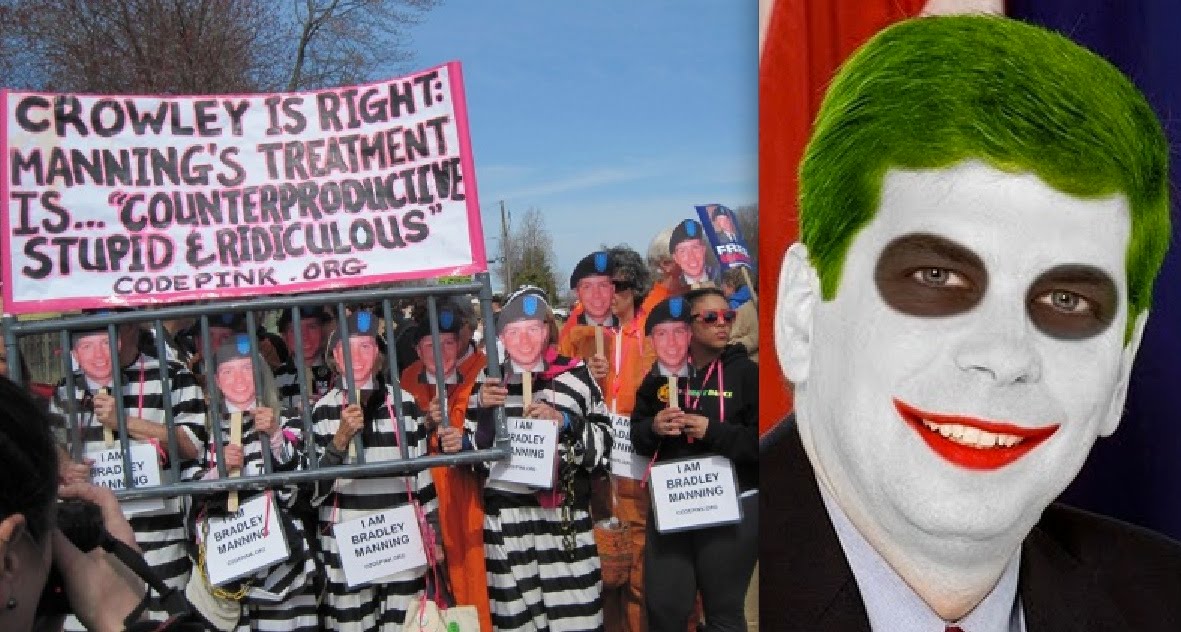
OBAMA: So people can have philosophical views [about Bradley Manning] but I can’t conduct diplomacy on an open source [basis]… That’s not how the world works.
And if you’re in the military… And I have to abide by certain rules of classified information. If I were to release material I weren’t allowed to, I’d be breaking the law.

We’re a nation of laws! We don’t let individuals make their own decisions about how the laws operate. He broke the law.
[Q: Didn't he release evidence of war crimes?]

OBAMA: What he did was he dumped…

[Q: Isn't that just the same thing as what Daniel Ellsberg did?]

OBAMA: No it wasn’t the same thing. Ellsberg’s material wasn’t classified in the same way.
Obama is right. What Ellsberg published was troves and troves of highly classified top secret and ultra top secret documents. What Manning allegedly did was to pass on classified information, much of it about war crimes and financial crimes of America's biggest banks and corporations. They are not the same thing. Ellsberg's act was far more serious in real terms, though Manning is, of course, a member of the U.S. military.


There are a number of problems that glare at one from Obama's incredible statement. First of all, there is the obvious fact that Manning has not been convicted of anything. The second, is the concern that Obama has now tainted the jury pool. Here's what happened to the Manson jury, as a result of Nixon's statement:
Jurors, already sequestered in the Los Angeles, were protected from the next day’s four-inch headlines by papering over the windows of the courthouse: “MANSON GUILTY, NIXON DECLARES.”
There's a big difference here, beyond the above, though. If Manning is ever tried (some doubt he will be), it will be before a military court martial, whose members will all see Obama as their Commander-in-Chief.

Obama's Q&A quoted above was a result of the flash mob event earlier yesterday, at a fundraiser in San Francisco. Here's how it was covered at FOX News:


Translation - it takes a major gaffe by Obama for FOX to cover Manning. Here's a more sympathetic story on the flash mob, by Alyona Minkovsky on RT TV:


Obama's staff isn't nearly as capable, or perhaps moral as that of Richard Nixon. What might there to be learned from that?

Hat tips - Teddy Partridge and Michael Whitney

Thursday, April 21, 2011

Catching Up on the Bradley Manning Case - Here, in DC, Leavenworth and With the President This Morning in San Francisco

A lot has happened regarding Army PFC Bradley Manning's case, and public perception of it since PA last covered this on April 12th.

I. My efforts to get a rational response to Bradley's mistreatment from Alaska U.S. Senator Mark Begich, who sits on the Armed Forces Committee have not only gotten nowhere, it doesn't appear they will. Last weekend Mark was in the Mat-Su Valley several times, as he spent over a week travelling around Alaska. At two of the events in the Valley, I might normally have been part of the crowd. As a former Begich volunteer and contributor, an active local Democrat and strong 2008 supporter, I would normally have been invited to these two happenings. Here's how I related this to some friends:

I delivered a letter [to Begich], co-signed by many here at fdl, to his Wasilla office on March 8th. His response, on March 10th, was delivered to a dead address, so I never got it.

Meanwhile, I interviewed Begich’s predecessor in the US Senate, Mike Gravel, who appealed to Mark to do the right thing.

Last week, as I was hoping to set up a meeting with Sen. Begich while he is here in Alaska, I finally discovered the existence of the undelivered letter. I hoped to be able to meet with Sen. Begich while he was attending events in the Mat-Su Valley associated with organizations I either support or am a member of. When I inquired about meeting with Begich at two of these, I was asked by local Democrats to please not attend, as I would be unwelcome.

I tried to get in touch with Sen. Begich through his Wasilla staff person, Mary Kvalheim, a long-time friend. She was told not to return my calls. His press secretary, Julie Hasquet, who used to be a friend, wrote me, informing me that she is the sole person with whom I should attempt to set up any contact with the Senator (I’ve had to deal with Begich’s Wasilla and DC staff, since Julie wrote to me in 2010, saying that she doesn’t intend to forward any of my letters to Mark).

Here’s what Julie wrote to me yesterday:

Hi Phil,
If you are ever seeking an interview or time to ask Senator Begich some questions, please call me to arrange.
Staff does not set up time with media, that all goes through me.

Thanks. Julie

Frustrating, because in the past, she has told me I don’t qualify as “press” as a “blogger.” I wrote back:

Julie,

What I would like to do is sit down with Mark, show him Mike Gravel’s appeal to him, go over the NYRB law professor letter with him (the salient points related to Mark’s responsibilities as a member of the Senate AFC), the refusal by the DoD to allow either Rep. Kucinich or the UN rapporteur on human rights visit Manning without monitoring, and get his response on video. All the items I describe have happened since Mark wrote his reply to me, so it is all new.

Julie replied an hour ago:

Phil,
Should Sen. Begich change his views in regards to the case of PFC Manning, other than what was relayed in his recent letter, we will let you know.
At this time, he has nothing to add to what he wrote to you a few weeks ago.
Thanks. Julie

Times like that make me want to leave the Democratic Party, but they're stuck with me for now.

II. On Tuesday a Pentagon leaker let it out that Manning was about to be transferred from the Marine Base Quantico brig to the large Army prison at Ft. Leavenworth, Kansas. Before Manning's attorneys even were legally informed, the Pentsagon held a short press conference in Washington DC:


Reaction to the announcement has been mixed. Here's Rep. Dennis Kucinich stating "I don't believe anything they say when it comes to Bradley Manning:


Here's MSNBC's Dylan Ratigan discussing Manning's transfer with P.J. Crowley (who left the State Department over Manning's treatment) and firedoglake's Jane Hamsher:


This morning at a DLC fundraiser in San Francisco, some true Democrats and patriots confronted Obama with a song, flashmob style:


Thanks to everyone who helped here at at fdl by signing the letter to Sen. Begich.

Saradise Lost - Book 5 - Chapter 46: Palin No More Popular in Alaska Than in Madison

Dave Dittman's recent poll on the popularity, and inferring the relative popularity of Alaska's most notable politicians, suggests another sampling. I have a hunch that if Alaskans were polled on whether or not they would like Palin to leave Alaska for good, more than half would want her to go; and that if people in the lower 48 were polled on whether or not they would like Palin to leave there and return to the frozen North forever, they would wish her back upon us permanently.

In three years, Palin has inexorably slid from perhaps the most popular politician in Alaska history to one of the least. Gauging from the number of my friends who used to be ardent Palin supporters who now despise her, she has done much to earn her current position.

She had help: Eddie Burke, John Zeigler, Glenn Beck, her increasingly weird dad, and our favorite in the Alaska left blogosphere - the indefatigable Rebecca Mansour, or RAM, Palin's preeminent ghost voice.

Here's Amanda Coyne on the poll:

Some of the results on Palin:

  • 61 percent of Alaskans had an "unfavorable" view
  • 39 percent of those had a "very unfavorable" view
  • 13 percent had a "very favorable" view

The former governor's numbers had fallen since an April 2010 Dittman poll, when 46 percent responded favorably and 52 percent of respondents viewed her unfavorably.

And that 2010 poll was down considerably from her post-2008 bribe (called the "energy rebate") numbers, which were somewhere around 110%.

RAM was pissed that not enough people paid attention to Palin's Saturday speech in Madison, Wisconsin. The way Mansour went about it pissed even more people off - she tweeted away at all sorts of media:
Of all the complaints Sarah Palin has made about the media, here's a new one: One of her advisers is apparently upset about a lack of press coverage.

As Slate's Dave Weigel noted this morning, Rebecca Mansour, a top Palin aide, posted several messages on Twitter Monday directed at news organizations including ABC News and CNN, implying the media had not adequately covered a speech Palin gave at a Wisconsin tea party rally on Saturday.

"Hi @CNN did you cover @SarahPalinUSA's Madison speech? Did it upset you that she made Obama look bad by saying the stuff you gloss over?" Mansour wrote.

She directed similar messages to the Huffington Post, MSNBC, NBC's Andrea Mitchell, the Washington Post and CBS.

What's odd is that Palin's speech actually did receive a lot of coverage--though perhaps not as much coverage as the former Alaska governor is used to. ABC ran a story on its website. The Huffington Post and Washington Post linked to the Associated Press's coverage of the event.

MSNBC played video excerpts of Palin's speech several times Monday, highlighting the former governor's call for the GOP to "fight like a girl" and questioning if it was her comeback. Meanwhile CNN covered the event on air and on its blog—which Mansour later acknowledged in a follow-up Tweet.

After Weigel noted the the Palin aide's messages in a blog post this morning, Mansour lambasted the item on, you guessed it, Twitter, insisting the Slate writer has a "zero sense of humor."

"Just to be clear: I wasn't demanding media attention," Mansour said in a message directed at Weigel. "I was mocking the media about which Palin stories they choose to cover."

Palin will do just about anything to stay in the news. She's perhaps the most cynical politician in American history in terms of exploiting any and all her kids. Any screw up in the way the media treats her brood and - WHAM!!! - her usually inept publicity machine turns into a well-oiled mechanism:

I'm certainly not defending Wonkette. The humor site lost much of its bite when its founder, Ana Marie Cox, left in early 2006. That's over five years ago, before Palin was even elected governor of Alaska.

I'd like to see a poll comparing Palin's favorables right now to such figures as Vic Kohring, Pete Kott, Bill Allen, Bill Weimar, Frank Murkowski or - Robert Hanson - just to make it interesting.

Paraphrasing Julia O'Malley from a week ago: Sarah - Make. It. Stop!

Wednesday, April 20, 2011

Twenty Signs of a Coming Horrific World Food Crisis

The following are 20 signs that a horrific global food crisis [may be] coming....

#1 According to the World Bank, 44 million people around the globe have been pushed into extreme poverty since last June because of rising food prices.

#2 The world is losing topsoil at an astounding rate. In fact, according to Lester Brown, "one third of the world's cropland is losing topsoil faster than new soil is forming through natural processes".

#3 Due to U.S. ethanol subsidies, almost a third of all corn grown in the United States is now used for fuel. This is putting a lot of stress on the price of corn.

#4 Due to a lack of water, some countries in the Middle East find themselves forced to almost totally rely on other nations for basic food staples. For example, it is being projected that there will be no more wheat production in Saudi Arabia by the year 2012.

#5 Water tables all over the globe are being depleted at an alarming rate due to "overpumping". According to the World Bank, there are 130 million people in China and 175 million people in India that are being fed with grain with water that is being pumped out of aquifers faster than it can be replaced. So what happens once all of that water is gone?

#6 In the United States, the systematic depletion of the Ogallala Aquifer could eventually turn "America's Breadbasket" back into the "Dust Bowl".

#7 Diseases such as UG99 wheat rust are wiping out increasingly large segments of the world food supply.

#8 The tsunami and subsequent nuclear crisis in Japan have rendered vast agricultural areas in that nation unusable. In fact, there are many that believe that eventually a significant portion of northern Japan will be considered to be uninhabitable. Not only that, many are now convinced that the Japanese economy, the third largest economy in the world, is likely to totally collapse as a result of all this.

#9 The price of oil may be the biggest factor on this list. The way that we produce our food is very heavily dependent on oil. The way that we transport our food is very heavily dependent on oil. When you have skyrocketing oil prices, our entire food production system becomes much more expensive. If the price of oil continues to stay high, we are going to see much higher food prices and some forms of food production will no longer make economic sense at all.

#10 At some point the world could experience a very serious fertilizer shortage. According to scientists with the Global Phosphorus Research Initiative, the world is not going to have enough phosphorous to meet agricultural demand in just 30 to 40 years.

#11 Food inflation is already devastating many economies around the globe. For example, India is dealing with an annual food inflation rate of 18 percent.

#12 According to the United Nations, the global price of food reached a new all-time high in February.

#13 According to the World Bank, the global price of food has risen 36% over the past 12 months.

#14 The commodity price of wheat has approximately doubled since last summer.

#15 The commodity price of corn has also about doubled since last summer.

#16 The commodity price of soybeans is up about 50% since last June.

#17 The commodity price of orange juice has doubled since 2009.

#18 There are about 3 billion people around the globe that live on the equivalent of 2 dollars a day or less and the world was already on the verge of economic disaster before this year even began.

#19 2011 has already been one of the craziest years since World War 2. Revolutions have swept across the Middle East, the United States has gotten involved in the civil war in Libya, Europe is on the verge of a financial meltdown and the U.S. dollar is dying. None of this is good news for global food production.

#20 There have been persistent rumors of shortages at some of the biggest suppliers of emergency food in the United States.

The Paradox of April in Alaska

Judy took this picture of bees on crocus flowers on Monday, down at Chenega Bay in Southwest Prince William Sound. Almost has the feel of summer to it, eh?

But all around us, as the snow rapidly melts in the warming sunshine, the debris of winter is being uncovered: along roadsides, in median strips, in parking lots, in our own front and back yards. I don't have to take pictures of that. We all know what it looks like.

April is one of my favorite months here. It has been since my first full spring in Alaska, when my friend KC Condon and I bought the Swanee in Cordova, and worked on it in Banta's Boatyard, in the sunshine, melting snow and emerging piles of dog poop all around us. In early April, we were in our snow gear. By late April, we were working in our t-shirts. In Whittier, April was time to put everything back together around the harbor I ran for five years, or to take hunters out on bear hunting charters.

April is the transitional month in much of Alaska that March is in most of the rest of the USA. It is also the month that pulls many of us out of the winter blues or doldrums or funk. Yet I'm always glad when May arrives, with so many leaves, flowers and plants growing so rapidly, and the light returning all night.

Tuesday, April 19, 2011

Sarah Palin's Version Of Trig's Birth May Be More Troubling Than The Hoax

--- by Geoffrey Dunn *

This past week, the draft of an academic paper that focuses on the 2008 birth of Sarah Palin's son, Trig Paxson Van Palin, and the various theories that surround his birth, was made public prior to publication through a university newspaper and then exploded, quite predictably, on the Palin-centric blogosphere, where Trig's birth remains a cause célèbre and the source of considerable controversy. It has now spilled over into the mainstream media as well.

"Palin, the Press, and the Fake Pregnancy Rumor: Did a Spiral of Silence Shut Down the Story?" written by Bradford W. Scharlott, Ph.D., an associate professor at Northern Kentucky University, comes to two primary conclusions: 1) that Palin "likely" staged "a hoax" concerning the birth of her son Trig; and 2) that "a spiral of silence" prevented the mainstream U.S. media from adequately investigating the circumstances of Trig's birth.

As both a life-long journalist and an academic--and perhaps most importantly, as the author of the forthcoming book, The Lies of Sarah Palin: The Untold Story Behind Her Relentless Quest for Power--I read Scharlott's draft thesis with considerable interest and anticipation.

Scharlott's initial contention that Palin orchestrated an elaborate "hoax" around the birth of Trig does not hold up to close scrutiny. It remains a premise, not a fact. That said, his second assertion about "the spiral of silence" raises several issues about Palin, her birth story and the mainstream media that must be scrutinized fully as Palin continues to position herself for a run in the 2012 Republican primaries.

In the end--as is the case with virtually all things Palin--the most troubling scenario regarding Trig's birth is the one proffered by Palin herself--a scenario that has been largely muted, or disregarded, by the focus on Trig's birth as being a "hoax."

Let me acknowledge that while researching my book I spent a considerable amount of time and resources trying to sort out the facts of Trig's birth. As with many elements of Palin's life story, there are disquieting discrepancies between what actually happened and Palin's version of events. Her capacity for deceit simply knows no bounds, and this duplicity has contributed significantly to the atmosphere of doubt regarding the details of Trig's birth. Contrary to Palin's contention otherwise, the rumors that Trig was not her son originated long before she was named as John McCain's running mate, commencing immediately upon her public acknowledgment, in March of 2008, that she was pregnant.

Palin, by her own account in Going Rogue, did not tell anyone but her husband Todd that she was pregnant with what would be the couple's fifth child. She kept the news from her parents, siblings, children and her closest staff--odd behavior under any circumstances. Moreover, she did not tell members of her family that the child she was carrying had been diagnosed with Down syndrome. So when Palin announced being seven months pregnant--to a handful of reporters in Juneau on March 5, 2008--the rumor mill went into overtime.

Hoping to disprove the conspiracy theory when I initiated work on my book--and to put the story to bed once and for all--I interviewed several close associates of Palin's, including her friends and political allies. I was anticipating, perhaps even hoping, that they would tell me conclusively that Trig was her child.

I was shocked by the response. One close friend of Palin's--a widely respected woman who had given birth to several children as well and who had close contact with Palin in Juneau up until the time of Trig's birth--told me that "Palin did not look like she was pregnant. Ever. Even when she had the bulging belly, I never felt that the rest of her body, her face especially, looked like she was pregnant." When I asked her point-blank if she was certain the baby was Palin's, she said, "No. I don't know what to believe."

The news of Palin's pregnancy came as a complete surprise to Palin's State Trooper security detail Gary Wheeler, a well-liked, 26-year veteran of the Alaska State Troopers who worked under several administrations in Alaska state government, both Republicans and Democrats. Only two weeks earlier, in late February of 2008, Wheeler had accompanied Palin back to Washington, D.C. for a Republican Governors Association Conference, where she had just met John McCain and his campaign manager Rick Davis, who was to be in charge of the vice-presidential nomination selection process. Wheeler remembers that Palin had changed into jeans upon her arrival in Washington, with no apparent revelation of pregnancy.

Wheeler also said that his wife, Corky, actually made fun of him when the news came out because he was supposed to be a "trained observer." Wheeler simply shakes his head: "I had nary an idea she was packin'."

As Wesley Loy of the Anchorage Daily News reported it at the time, Governor Palin "shocked and awed just about everybody around the Capitol" with her announcement.

This is at seven months.

More significantly--and thus begins the troubling nature of even Palin's own account--according to Wheeler, Palin did not tell the Alaska State Troopers who were assigned to protect her that she was pregnant, even though her age and the fact that she was carrying a child with Down syndrome presented potential health complications. All of this both foreshadows and serves as an important prelude to Palin's troubling journey from Texas to Alaska, during which she was experiencing--again by her own account--early signs of childbirth, including the so-called breaking of her waters.

Palin was scheduled to make a speech at an RGA energy conference in Dallas on April 17, slightly less than eight months into her pregnancy. At the last moment before her trip to Texas--which involved a stopover in Seattle--Wheeler says that Palin made an "out-of-the-ordinary" announcement that she wouldn't be needing a Trooper to accompany her on her junket, and that her husband Todd would be traveling with her instead. An email written by Palin--obtained through a Alaska Public Records Act request--confirms Wheeler's recollection. At 9:26 on the morning of April 14, 2008, only a day before her scheduled departure, Palin sent the following email to her administrative assistant, Janice Mason:

J- instead of rga paying for staff, and/or rga (or state) paying for Security on this Texas trip, pis let them know First Spouse is available to travel instead - they can pay for Todd. Pls chk on flt availability for him (on my flts). [sic] Thanks

I cover the ensuing details of Palin's so-called "wild ride" from Texas back to Alaska in considerable detail in my book, but in short--according to information she gave at a news conference immediately following her return--Palin claimed that she called her physician in the middle of the night from her hotel room in Texas to discuss what Palin referred to as "amniotic fluid leaking." Despite the presence of this fluid--a strong indicator of impending birth and which potentially exposed Palin and her child to infection--Palin stayed in Dallas and delivered her speech later that day.

Rather than getting checked at a nearby hospital in Dallas before her departure (Baylor Medical Center was less than ten minutes away), Palin and her husband commenced on their return flight home to Anchorage via Seattle. They did not tell flight attendants of Palin's medical situation. The failure of the Palins to inform airline personnel of her impending medical situation not only put her infant and herself at risk, it also potentially put all passengers and staff on the two flights at risk as well. As The Atlantic's Andrew Sullivan (who deserves a commendation for keeping this story from being buried completely) dubbed it, Palin's decisions were "reckless beyond measure."

Once returning to Anchorage late in the evening of April 17, Palin claims to have bypassed the Providence Hospital in Anchorage (which has a neonatal intensive-care unit and is located only a few minutes from the Ted Stevens International Airport) for the roughly hour-long drive to the Mat-Su Regional Medical Center, located just off the Parks Highway, roughly seven miles outside of Wasilla (and which has no neonatal intensive-care unit).

Three days after Trig's birth, Palin and her husband held a news conference in Anchorage, with Trig joining them. The audio recording of the news conference provides a fascinating glimpse into the Palins' mindset at the time of Trig's birth and their chafing at criticism of their decision to fly back to Alaska. Again, I cite several passages from the press conference in my book, but what follows are some highlights:

Sarah Palin: Well that was again if, if I must get personal, technical about this at the same time, um, it was one, it was a sign that I knew, um, could lead to uh, labor being uh kind of kicked in there was any kind of, um, amniotic leaking, amniotic fluid leaking, so when, when that happened we decided OK let's call her [her physician, Cathy Baldwin-Johnson].

The answer was classic Palin--evasive, circuitous, garbled and indirect. In fact, The Anchorage Daily News story the following day, by Kyle Hopkins, reported that Palin had not asked her physician "for a medical OK to fly."

Hopkins also contacted an obstetrician in California, Dr. Laurie Gregg, active in the American College of Obstetricians and Gynecologists, who said that "when a pregnant woman's water breaks, she should go right to the hospital because of the risk of infection. That's true even if the amniotic fluid simply leaks out."

As for the distinction that Palin was trying to make between "breaking" and "leaking," Gregg was not buying into it. "To us, leaking and broken, we are talking the same thing," Gregg asserted. "We are talking doctor-speak."

The Palins were clearly irritated by the direction of the questioning. "There's a lot of new doctors out there on the streets in the last couple of days," Todd Palin asserted irritably.

An aide to the Palins decided it was time to wrap things up. One final question was allowed.

Reporter: Was it important to you to have the baby in Alaska?

Sarah Palin: It was very important that we have...it was more important that, that Trig arrive safely and healthy and um, and that is exactly what happened. The extra blessing was that Trig was able to be born into this great state, you know, kind of like, I feel like this extended Alaskan family, that he was here, for that.

Todd Palin: Can't have a fish-picker from Texas.

That became the family mantra.

There have also been a number of discrepancies in Palin's story. In Going Rogue, for instance, she makes no mention of her waters breaking. At a speech delivered in Waco, Texas, last year, Palin claimed that she delivered Trig in Anchorage. (Note the passage at 16:55 into her speech.)

The response to Scharlott's paper has been both troubling and predictable. On the one hand, those who continue to subscribe to the "hoax" theory have championed it as a work of academic brilliance. On the other hand, Palin's former flack Bill McAllister threatened to "slap" Scharlott and said that in "a different era," he'd have challenged Scharlott to "a duel." Salon's Justin Elliot used the occasion to take a cheap shot at Andrew Sullivan by describing him as a practitioner of "Trug Trutherism" -- the belief "that Sarah Palin faked her 2008 pregnancy because Trig is actually the son of Bristol Palin"--when, in fact, all Sullivan has ever asserted is the absence of "easily available and definitive" evidence that Palin is the mother of Trig.

And in what can be described only as pathetic response to Scharlott's paper, Anchorage Daily News columnist Julia O'Malley contradicted her own newspaper's body of work on this matter by invoking a "spiral of silence" perspective and demanding that "someone" should "Make. It. Stop." She doesn't say who and she doesn't say how. What she means is that she doesn't want the issue even discussed.

Perhaps O'Malley was too high on her horse to recall that in December of 2008, in the aftermath of the national election, the Anchorage Daily News tried to confirm once and for all--as did I--that Sarah Palin was the mother of Trig, only to be rebuffed by Palin herself. The ADN's executive editor Pat Dougherty assigned his fine reporter Lisa Demer to the task of investigating the rumor. But a story was never published.

On December 31, Palin sent Dougherty an email attacking him for the line of questioning:

And is your paper really still pursuing the sensational lie that I am not Trig's mother? Is it true you have a reporter still bothering my state office, my very busy doctor (who's already set the record straight for you), and the school district, in pursuit of your ridiculous conspiracy?

Dougherty's response should be of particular interest given O'Malley's commentary. He said that his goal was "to let a reporter try to do a story about the 'conspiracy theory that would not die' and, possibly, report the facts of Trig's birth thoroughly enough to kill the nonsense once and for all." Dougherty said that Demer received "very little cooperation" from Palin or her family. He killed the story. But he made a telling observation to Palin:

It strikes me that if there is never a clear, contemporaneous public record of what transpired with Trig's birth, that may actually ensure that the conspiracy theory never dies.

And there's the rub. O'Malley's own editor did not Make It Stop because Sarah Palin has never provided sufficient concrete evidence to put the conspiracy theories to bed. She hadn't in 2009, and she hasn't now. The problem is rooted not in the wild imaginations of bloggers, as O'Malley would have us believe, but in the calculated obfuscation of the issue by Sarah Palin herself.

A week after her email to Dougherty, Palin issued a formal State of Alaska press release from the Governor's office. "As a public official, I expect criticism and I expect to be held accountable for how I govern," Gov. Palin said. "But the personal, salacious nature of recent reporting, and often the refusal of the media to correct obvious mistakes, unfortunately discredits too many in journalism today, making it difficult for many Americans to believe what they see in the media."

Held accountable? Throughout her political career, Sarah Palin has been the master of the dodge. She has never held herself accountable. At one point she claimed that she had made Trig's birth certificate public; she did not. The hospital has never issued a formal birth notice. She said that she would make her health records public. She did not. It was another lie.

This past week Palin had the gall to giggle and smirk her way through an interview on Fox News in which she supported Donald Trump's investigation of President Obama's birth certificate in Hawaii: "Well, uh, I appreciate that 'The Donald' wants to spend his resources in getting to the bottom of something that so interests him and many Americansm," Palin opined. "You know, more power to him."

The hypocrisy is staggering. There is one person who can put an end to the Trig matter immediately and instantly, and that is Sarah Palin. Before she takes another step in what has been a hapless bid to position herself for a run for the presidency, the American media should demand that Palin produce full and conclusive evidence of Trig's birth and parentage. It's that simple.

Once that step is taken, then the American media needs to break its "spiral of silence" about Palin's "wild ride" from Texas to Alaska and to demand direct answers from her about the decisions she made, the actions she took and what motivated her to do so. Anyone who examines Palin's own story closely will come to no other conclusion that she was "reckless beyond measure"--as Andrew Sullivan so succinctly put it--and entirely unqualified to hold higher office in these challenging and demanding times.

Geoffrey Dunn is the author of the forthcoming book The Lies of Sarah Palin.

[* reprinted with permission of the author]