Monday, May 16, 2011

Israel Harms Palestinians, but Also Itself

--- by Mike Gravel

My concern for the Israeli-Arab conflict is a personal one. I was raised in a Jewish neighborhood -- three synagogues within three blocks of our home in Springfield, Mass. -- which sensitized me to Jewish culture and history. As a young student of world affairs, I closely followed the history of the Holocaust and Israel's birth in Palestine.

On the other hand, I also had a close boyhood friend whose family had roots in Syria and Lebanon; they exposed me to the local Lebanese community. The Middle East conflict was part of my global political awakening.

During my 12 years in the U.S. Senate I enjoyed the support of a number of Jewish organizations, most notably the American Israel Public Affairs Committee (AIPAC), the preeminent "pro-Israel" lobbying organization. For a time, I had a perfect voting record in support of Israel.

On several trips to Israel and the Middle East, I developed contacts at the highest levels of the Israeli government and the Palestine Liberation Organization (PLO). These trips were discouraging; the possibility of peace seemed unattainable -- until the courageous leadership of Egyptian President Anwar Sadat emerged.

My political rupture with AIPAC occurred over a vote for military aid to Egypt, Saudi Arabia and Israel. This legislative package of aid was put together by the White House primarily to shore up support for Sadat in the Middle East. AIPAC opposed the package and hoped to muster enough congressional opposition to pressure the White House to stop the military aid package to Egypt and Saudi Arabia.

But on this occasion, Sadat's overture to Israel was too significant a factor. This was a rare instance in which AIPAC didn't "win" on an issue. Interestingly, my vote was the same as those of Sens. Jacob Javits (New York) and Abraham Ribicoff (Connecticut), two Jewish leaders at that time in Congress and the nation. They also recognized the importance of supporting Sadat and were not intimidated by pressure from AIPAC.

This event underscores the nature of the Israel lobby in Washington. Political positions and decisions within AIPAC were and continue to be profoundly influenced by the Israeli government.

The tragedy is that much of the nation's progressive Jewish community defers to Likud-like organizations, and too many Jewish donors -- as with Christian Zionists -- buy into fear-mongering and rationalizations for anti-Palestinian discrimination transmitted from abroad. A Jewish community once at the forefront of pushing for civil rights and equality in our own country too often today supports organizations and candidates upholding Israeli discrimination in the West Bank and East Jerusalem and, increasingly, within Israel itself.

When I left office in 1981, Israeli leaders were increasingly succumbing to a bunker mentality, sustained by fear and a history of oppression that has long since changed. The Israel I admired is difficult to recognize, save in the actions of young Jewish demonstrators helping Palestinians to protest Israel's expansionist West Bank barrier. Israel has been captured by the religious right with its sense of entitlement to Palestinian land.

The dangerous political leadership of Prime Minister Benjamin Netanyahu and his oppressive domination of the Palestinians in Gaza and the West Bank must be opposed. He does not want peace. Instead, Israel continues to build on the ethnic cleansing it perpetrated in 1948. The colonization effort in occupied Palestinian territory is thriving under Netanyahu.

Unfortunately, I expect the U.S. Congress to give Netanyahu thunderous applause later this month in a joint meeting as he obscures Israeli discrimination against Palestinians. Likewise, this month will see many American politicians beat a path to the annual AIPAC conference, where speaker after speaker will identify threats against Israel without noting the enormous harm Israel is causing itself -- and Palestinians -- with a repressive occupation fast approaching half a century in age.

Until Israel's leadership and policies change, we will not see regional peace. Unless American leaders acquire a more balanced approach, and become more supportive of Palestinian aspirations for freedom, the United States will not be able to act as a fair broker for peace.

After 1948: How Israel stopped the “outcast race” from returning home

--- by Max Blumenthal

Yesterday, the Israeli army opened fire on unarmed demonstrators seeking to reach Majdel Shams, a village in the occupied Golan Heights. When the demonstrators breached a border fence, the army opened fire, killing several of them. Among those who made it through was Hassan Hijazi. Hijazi hitch-hiked and rode buses from the border to Jaffa, hoping to find his family’s confiscated home. “It was always my dream to reach Jaffa,” he told police after turning himself in.


At the Gaza border, the army opened fire on unarmed demonstrators with tanks, injuring dozens. Israeli forces fired unusually high amounts of teargas at protesters in Qalandiya, wounding scores in the West Bank city which was completely surrounded by the separation wall. Joseph Dana, who documented the Qalandiya protest, told me a group of shabab attempted to pull down a section of the wall but failed in somewhat comical fashion because their rope was too short.

Now that Israeli forces are conducting house-to-house searches for those who managed to surmount the Jewish state’s demographic walls, the word “infiltrator” has retured to the Israeli vocabulary. The term was coined in the months and years after the Nakba when the Israeli military focused on preventing those it had expelled in 1947 and ‘48 from returning to their villages, their land and their families. Israel’s search and expulsion operations, designed to maintain the demographic integrity that the Zionist militias established through ethnic cleansing, represent an under-acknowledged but absolutely crucial component of the history of the Nakba. Indeed, the Nakba did not end in 1948.

Perhaps the most comprehensive account of Israel’s efforts to prevent the refugees from returning home is Benny Morris’ 1993 book, “Israel’s Border Wars: 1949-1956.” Morris’ flaws — his crude racism, rejection of Arab historians and sources, and allegiance to Zionism — are well known. As a pure archivist, however, he is among the best. The sections in his book on infiltration depict in cold, clinical detail the Israeli military’s tactics against those who tried to return. They included detaining refugees in barbed wire enclosed camps that reminded some observers of Nazi German; the extraction of fingernails and other torture methods; and forced marches through the desert without food or water. Tawfiq Toubi, the first Arab to serve in Israel’s Knesset, called the search and expulsion operations “pogroms.”

Below, I have excerpted several testimonies about Israel’s operations to stop “infiltration:”

In May 1950, a woman from a kibbutz in the South witnessed Palestinian refugees being packed into trucks and unloaded at a camp [pp. 147-48]:

We were waiting for a hitch beside one of the big army camps… Suddenly two large trucks arrived, packed with blindfolded Arabs (men, women, and children). Several of the soldiers guarding them got down to drink and eat a little, while the rest stayed on guard. To our question ‘Who are these Arabs?’ they responded: ‘These are infiltrators, on their way to being returned over the borders.’ The way the Arabs were crowded together [on the trucks] was inhuman. Then one of the soldiers called his friend ‘the expert’ to make some order [among the Arabs]. Those of us standing nearby had witnessed no bad behavior on the part of the Arabs, who sat frightened, almost one on top of the other. But the soldiers were quick to teach us what they meant by ‘order. The ‘expert’ jumped up and began to…hit [the Arabs] across their blindfolded eyes and when he had finished, he stamped on all of them and then, in the end, laughed uproariously and with satisfaction at his heroism. We were shocked by this despicable act. I ask, does this not remind us exactly of the Nazi acts towards the Jews? And who is responsible for such acts of brutality committed time and time again by our soldiers?

In June 1949, Israeli forces rounded up 5000 accused infiltrators in Nazareth and imprisoned them in a barbed-wire compound. The episode disturbed then-Foreign Minister Moshe Sharett, who worried for Israel’s international image. He complained to Ben Gurion [p. 149]:

The army did not allow anyone to remain at home. Among those incarcerated [behind the barbed wire] there were also pregnant women, babies, tired old people, and the sick. The army made no distinction between ordinary folk and notables, so that among those incarcerated was the Arab magistrate of Nazareth… All these people were held in the compound for several hours, in overcrowded conditions, and without food and water. There were outbursts of shouting and yelling by the prisoners and on one occasion the troops fired over the crowd’s heads… I heard from a Jewish member of Knesset who visited Nazareth last Saturday that there had been thefts of money from [some] empty houses [during the round-up].

On May 31 1950, the Israeli army forced 120 Palestinian “infiltrators” into two crowded trucks and drove them to Arava, a point on the Jordanian border, then forced them to march across the desert, firing shots over their heads to urge them on. According to Alec Kirkbride, the British minister in Amman, over 30 died of thirst and starvation during the forced march. The group had spent the past weeks in a makeshift detention center in Qatra that Kirkbride described as ” a concentration camp…run on Nazi lines.” One survivor, according to Morris, had his fingernails torn out.

John Glubb, the latter-day Lawrence of Arabia who had trained the Jordanian army, witnessed the scene with horror. “The Jews want them all to emigrate,” he wrote. “They therefore try to persuade them with rubber coshes and by tearing off their fingernails whenever they get the chance… I do not know whether this is the policy of the Israel cabinet, but it must certainly be known and winked at on a ministerial level… The brutality is too general to be due only to the sadism of ordinary soldiers.”

On June 11 1950, the journalist Philip Toynbee (son of historian Arnold Toynbee) published an account on the front page of the Observer based on his interviews with the survivors of the Arava incident. Toynbee, whom Morris noted was “sympathetic towards Israel,” implied similarities between Israel and Nazi Germany. He wrote [pp. 160-61]:

One member of the outcast race [the Palestinians], a heavy young man with the dull vacant look of Van der Lubbe [the Dutchman falsely arrested and executed by the Nazis for setting fire to the Reichstag in 1933], had been arrested while grazing a cow near the state frontier. The blue-uniformed [Israeli] police with almost incredible naivete…believed him to be a spy… and two of his fingernails were pulled out before they learned better. A young schoolmaster entered [Israel] illegally in order to be again with his family. He was…immediately arrested. One old mason, driven desperate by unemployment, tried to get out of [Israel] to escape. About a hundred of them collected from all parts of the State were taken from the prison camp, [and] herded into two motor trucks… The army blind[folded] them, barking at them and waving their rubber coshes.

On the long tedious journey through the burning countryside one of the victims would occasionally try to see but was hit over the face or back with a cosh…At last…they reached the remotest…part of the frontier. It was no eight o’clock in the evening and they had had nothing to eat and drink all day. A compassionate captain ordered two buckets of water to be brought, but as soon as his back was turned the soldiers spilled the water into the dust. The bandages were now taken from their eyes and they were told that three would be counted and anyone not running by then would be shot…As they ran Bren gunfire opened above and between them so that they were forced to split up into groups of three and four. This story, I know, is sickeningly familiar, and it is only the roles which have been changed. The outcast race is not the Jews and the state is not…Nazi Germany…

The frontier area is the terrible Wadi Araba…a desert valley far below sea level where only lizards and locusts can live, and where in the daytime the sand scorches the bare flesh. Since there was only moonlight when the prisoners were released, nearly all were hopelessly lost by the time the sun rose…The luckiest were picked up on the second day by friendly Bedouins… Others were wandering for four days, eating lizards and drinking stagnant water or their own urine… By the fourth day some 70 out of 1000 had been saved, but many had stories of others they had been forced to leave dying in the desert… I interviewed nine or ten of them separately…their stories coincided… I saw weals and sores caused by prison beating, scorched and swollen feet, and two almost nailless fingers of the young grazier… Nothing can excuse the inhuman brutality of their treatment.

Moshe Dayan, who was then the head of the army’s Southern Command, blamed the atrocities at Arava on “Turkish and Moroccan [Jewish] soldiers” who “lack moral fiber.” He added, “I hope that there will perhaps be another opportunity in the future to transfer these Arabs from the Land of Israel, and as long as such a possibility exists, we must do nothing to foreclose the option.”

The Anchorage Civic Orchestra Performance of Peter and the Wolf

Saturday afternoon, as the highlight of the Anchorage Civic Orchestra's spring concert - Russian Pops - we performed Serge Prokofiev's perennial children's favorite, Peter and the Wolf. Our guest narrator was Shannyn Moore.

Linda Kellen Biegel made a video of the performance and has posted it on Youtube. The sound quality is pretty good, and she did a great job of getting the most out of a pocket camera.

Near the end of the first part I lost the grip on my baton, and it flew off into the violin section. After the concert, Shannyn told me she thought I might be flinging things at her, but - no - she did a sturdy job of telling a story she has treasured since her childhood.

Everyone in the orchestra did fine jobs, but special merits go to Emily Weaver on the oboe (the duck) and Carolyn Kozar on bassoon (grandpa).


Peter and the Wolf - Part One:


Part Two:


Part Three:


thanks, Linda!

Saturday, May 14, 2011

The Fracking Song

Warm, Sunny Days Bring Rapid Growth in the Greenhouse

Plants that I've started in the greenhouse are growing rapidly. I've had to transplant cabbages, zucchini and broccoli starters into larger temporary pots, as they've grown so much that the little six-pack starter containers were too little. I'll probably have to do that to some lettuce starts tomorrow.


64 beet plant starters, doing very well. We've been adding the little leaves to salads for a week now.

Lettuce and arugula plants in their containers. They'll go outside by mid-week.

And outside in the garden, the rhubarb is coming back so fast you can almost hear it grow.

Friday, May 13, 2011

Bohemian Rhapsody “too gay” for Wasilla? — Beyond the snark, bad situation for gay kids in Mat-Su schools


--- by E. Ross & Mel Green

Beyond the headline-catching absurdity of the short-lived Wasilla High School ban on “Bohemian Rhapsody,” there’s a more serious reality for LGBT students in the Mat-Su — one which hasn’t gained so much media attention.

by E. Ross and Mel Green

When the song “Bohemian Rhapsody” was pulled from the Wasilla High School graduation program because a parent complained that it was written by a gay man, Freddie Mercury of the British rock band Queen, a choir student called the Gay and Lesbian Community Center in Anchorage and the ACLU of Alaska, and the WHS principal backed down, saying he would allow a censored version of the song to be performed. As reported in the Mat-Su Valley Frontiersman,

“The whole thing was just ridiculous,” senior Rachel Clark said Monday. “They’d played the song on the school intercom and we played it at prom. It’s a great song and the choir was really excited to be singing it. And the senior class felt like it defined them.”

Choir member Casey Hight, a junior, was angry enough to contact a gay and lesbian support organization in Anchorage for help. They told her to contact an attorney at the American Civil Liberties Union.

“I felt like the school was discriminating for sexual orientation and I felt it was wrong,” Hight said Monday. “It’s so stupid because there’s nothing sexual in the song. There aren’t even any cuss words.”

The absurdity of banning a popular song because the writer was gay put Wasilla in the news again this week, as the story first reported in Frontiersman was picked up by numerous news sites and blogs both in Alaska and nationally, including the Anchorage Daily News, LGBTQ Nation, the Advocate, Pam’s House Blend, and Andrew Sullivan’s The Dish. The Mat-Su’s own Phil Munger of Progressive Alaska, Anchorage Daily News readers, and the national blog Gawker, among others, haven’t been shy about serving WHS administrators with a spoonful of snark — in particular noting Principal Dwight Probasco’s close resemblance to gay rock star Elton John.

But while editing out a stanza of a well-known song is also absurd, at least the Wasilla Symphonic Jazz Choir got to perform it in the end.

And beyond the headline-catching absurdity, the incident reflects a more serious reality for LGBT students in the Mat-Su — one which hasn’t gained so much media attention. Just a few weeks earlier, students were banned from bringing same sex dates to the Wasilla High prom, and were required to uphold a gender dress code of suits and tuxes for boys and dresses for girls. Not feeling any support in their local community, gay students just didn’t go to the Wasilla prom. Amber Sawyer, volunteer adviser for Wasilla High School’s Gay/Straight Alliance, and a recent UAA graduate, told Bent Alaska:

The students at Wasilla don’t feel like their school or really anyone in the community supports them….They told me the first time I ever met them that they felt like the principals at Wasilla didn’t even want their club to exist. They did not mention contacting anyone and they did not feel like they could do anything to change the policy.

Their fears were not unfounded. The Gay/Straight Alliance (GSA) club at neighboring Colony High School in Palmer, where Sawyer attended, was shut down by administrators when the GSA students asked for protection from the harassment members faced at school. Sawyer told Bent,

The high school I graduated from for example, Colony High, their club was shut down about two years after I graduated because of hazing and violence that happened against club members. The administration, rather than stopping the violence, stopped the club from existing.

Sawyer learned about the problems at Colony from friends who still went there. She elaborated:

[Colony High GSA members] had students singling them out in class and in the hallways, calling them names that were insulting and inappropriate. When the students complained the insults just started happening more out of the view of the administrators. Some teachers reportedly did not stop it but when the complaints from the students regarding harassment continued they were told the only way to completely stop being singled out was to disband the club. They were told that there was no way to completely stop the harassment so they needed to stop from having the club which created a way for them to be singled out.

And so, instead of attending their own hostile school proms, Mat-Su LGBT students on April 23 drove an hour south to Anchorage to attend Pride Prom, where they could dance together among friends and allies.
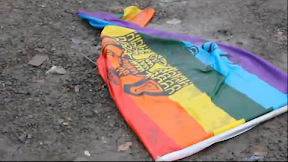
Vandalism at Alaska Pride Prom

But even in Anchorage, students were targeted. While 187 LGBT and allied youth from the Mat-Su and Anchorage were dancing inside at Out North Contemporary Art House, where the prom was held, vandals tore down the rainbow flags decorating the outside of the building, throwing some of them in the mud and hanging another upside down.

Bent Alaska posted a story and video about the incident, and the Anchorage Press followed up after discussion with Out North executive director Scott Schofield, who had sent out a press release about the vandalism the day after the prom. The Anchorage Press story also noted that Schofield’s press release was ignored by the Alaska mainstream media, none of whom reported on the incident.

Sawyer was concerned about both the vandalism and the silence. She wrote a letter to the Anchorage Assembly, also posting a copy on Bent Alaska’s Facebook wall:

The weekend before my graduation [from UAA], this happened. [link to the Anchorage Press story about the vandalism].

These were HIGH SCHOOL STUDENTS too young to vote and too young to be taken seriously by most politicians when they ask for help with anything. That is why some of them came to me.

In between completing my degree and living in Anchorage, I have been the advisor for the Gay Straight Alliance club at Wasilla High School. The students came in to this event [Pride Prom] here in Anchorage because they were banned from their own prom. They were not allowed to bring their dates, they were not allowed to dance together. This was the only place where they could celebrate the way kids are supposed to at a prom.

This is proof that discrimination happens. No one can say this was not intentional or that it was an accident. One flag is an accident. Every single flag, the only external decorations that the building had, were torn down and vandalized.

I have seen vandalism and hatred at the university but this cannot be ignored. Obviously the people are not going to be caught and therefore are going to get away with what they did. Calling no attention to it in addition to them receiving no punishment sends the message that they did nothing wrong.

If your child or niece or even one of your staff members were there, would you want the perpetrators of such vandalism to be allowed to be there as well? Next time will they stop with the flags or will they attack the cars of the individuals at the event? Something needs to be done. At this point there is no way to deny that the violence is happening. It is your responsibility as a representative of our community to address it.

Anchorage Assembly members Patrick Flynn and Elvi Gray-Jackson responded, thanking Sawyer for contacting them and saying they were committed to ending discrimination for all members of the Anchorage community. However, Mayor Dan Sullivan has made no sign that he would respond any better to protecting gay students than he did to protecting gay workers or renters. (In 2009, Mayor Sullivan vetoed Anchorage Ordinance A0-64, passed by the Anchorage Assembly, which would have prohibited discrimination in employment, housing, public accommodations, and education on the basis of sexual orientation and gender identity.)

As for Wasilla High School and Palmer’s Colony High School, they’re located in the Matanuska-Susitna Borough, which is outside the governance of the Municipality of Anchorage. And Matanuska-Susitna Borough School District does not even realize it has a problem with discrimination. Its Safe School Helpline reports that 22% of its calls involve harassment but — incredibly — 0% involve discrimination.
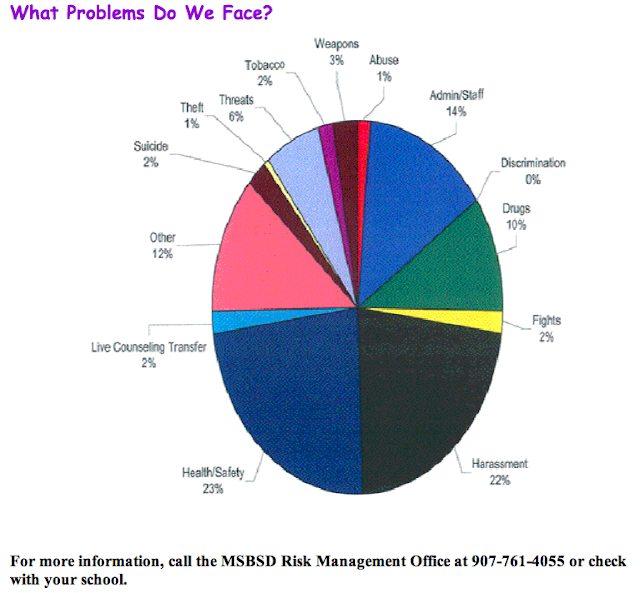
Mat-Su Borough School District Safe School Helpline

Bent Alaska is left with a few questions.

  • 22% of the calls involve harassment. What kind of harassment? Is anti-gay bullying a component of that? How much? And what is Mat-Su Borough School District doing about it?
  • How about the 6% of calls involving threats? Might those complaints of threats include the threats aimed at GSA members at Colony High School by hostile classmates, which Colony administrators chose to ignore — instead forcing Colony’s GSA club to shut down? Did that action by Colony administrators actually end the problem of antigay harassment and threats at the school, or did it merely shove it under the rug, so that Colony teachers and administrators and school district officials could ignore it and pretend it doesn’t exist?
  • What about at Wasilla High? If administrators were so sensitive about a song written by a gay songwriter, how sensitive are they to ensuring the safety of gay, lesbian, bisexual, and trans students, and ensuring they have a reasonable learning environment?
  • And if school and school district administrators are closing their eyes to problems at Wasilla and Colony high schools, how are they doing with all the other schools throughout the borough?
  • 2% of the calls were related to suicide. Are Mat-Su Borough School District officials aware of that kids who are bullied and harassed because they are (or are perceived to be) gay, lesbian, bisexual, or trans are at increased risk for suicide? Have they taken any steps to counter antigay bullying in the wake of the national publicity about the problem over the past year?

We hope and assume that there are staff members, teachers, and administrators throughout Mat-Su Borough School District who care about the safety and learning environment of LGBT students and their friends, as much as for non-LGBT students.

But the “Bohemian Rhapsody” incident — and everything else we’ve written about in this post — doesn’t lend us confidence that those who care are the ones making and enforcing policy.

We hope our readers — especially those who live in the Mat-Su and maybe even have children — will write to the school district and ask these questions too. And make sure, while you’re at it, that the Wasilla Warriors will be able to keep celebrating sports victories to the tune of Queen’s “We Are The Champions.”

Fukushima: It's Worse

--- by David Petraitis

Several people picked up on the Fukushima updates recently. A hat-tip to Krista Mahr of Time Online who in her article Fukushima: Er, Sorry…Worse Than We Thought repeats what I said yesterday about it being worse than we thought and pointed me to a Yomiuri Online report.

The Yomiuri Shimbun Online review of the situation has a very good image of the situation. Linked at right.

The commentary noted that TEPCO announced that the temperature apparently has stabilized, but that the water that has been pumped in has not covered the rods and now TEPCO believes that serious melting of the rods has occurred. [My emphasis]

TEPCO said the temperature in the pressure vessel is stabilized at 100 C to 120 C but that the water-entombment plan, in which water was expected to be filled to about 1 meter above the top of the fuel rods, needs to be reconsidered. The company is considering increasing the amount of water injected into the pressure vessel, which currently stands at about 8 tons per hour.

TEPCO learned about the water level of the pressure vessel after workers who entered the reactor building beginning Tuesday adjusted a water-level gauge. Previously, the reading of the water level had remained almost unchanged at about 1.6 meters below the top of fuel rods since immediately after the outbreak of the crisis at the plant following the March 11 earthquake and tsunami.

After adjusting the gauge, workers found the actual water level was more than 5 meters below the top of the fuel rods. As the fuel rods are about 4 meters long, they are considered to have been fully exposed above the cooling water, TEPCO said.

It said it believes the fuel rods mostly have fallen to the bottom of the pressure vessel after melting or collapsing.

I have no idea of what the adjustment of the gauge entailed, but that the readings were so far off must lead us to take with a large dose of skepticism the other status indicators released.

One thought leapt to my mind when reading the 8 tons per hour flow rate of the water coolant. “Where is all that water going?” and “How large is the Pressure Vessel anyway?” Well, later in the article I got my answer.

The company believes that most of the 190 tons of water injected every day is leaking from the pressure vessel, which is likely to be damaged more seriously than previously thought. More than 10,000 cubic meters of water had been injected into the reactor as of Thursday, exceeding the combined 360-cubic-meter capacity of the pressure vessel and the 7,800-cubic-meter capacity of the containment chamber.

It is highly likely that water is leaking from both the pressure vessel and containment chamber and flowing into underground parts of the reactor building and the adjacent turbine building,

There is nothing in the report to say where the water is finally ending up. The fuel rods are melted in the bottom of the pressure vessel, meaning that the plutonium and enriched uranium has escaped its zirconium cladding and is in contact directly with the cooling water. And that cooling water is leaking from the pressure vessel and the containment vessel. It will only be a matter of time before it is found in the environment around the plant: seawater, ground water, soil and air.

The only positive is that it appears, so far, that the reaction has stopped and that there is no hot meltdown of the core materials leading to a China Syndrome escape of nuclear material as happened with the infamous Elephant’s Foot of Chernobyl.

Krista Mahr pointed also to an article in the Japan Times by David McNeill that confirms that Iitate village in Fukushima province has to be cleared of all inhabitants, its crops and livestock destroyed:

By the end of the month, this mountainous farming village of 7,000 people in Fukushima Prefecture, recently voted one of Japan’s most beautiful places, will join the Ukrainian ghost town of Pripyat on the planet’s short list of nuclear casualties.

One of the most poignant tales is the callous prejudice and bullying that victims from Fukushima suffer at the hands of other Japanese:

Many have heard stories of children evacuated from the village, sometimes hundreds of kilometers away, being bullied, a painful echo of the decades-long discrimination that dogged survivors of the atomic bombings of Hiroshima and Nagasaki.

“I’ve heard that other kids shout ‘baikin’ (vermin) at them,” said Shoji’s granddaughter, Hiroko, 22.

This will be a 21st century morality story for years to come.

Crossposted from www.petraitis.us

Anchorage Civic Orchestra Russian Pops Concert Tomorrow at 4:30 PM

Dwight Probasco's Side of the Bohemian Rhapsody Story

When I got home from Anchorage Thursday evening, there was a phone message from Wasilla High School principal, Dwight Probasco. I'd written a blog post earlier in the day, based on a Frontiersman story written by K. T. McKee.

I called Dwight, and we talked for about 40 minutes. Here's as much of his side of the story as I think he'd like me to share:

The controversy over whether the Wasilla High School symphonic choir (which is a mix of all the school's choirs) might or might not be able to sing Bohemian Rhapsody, a mildly controversial song, at the 2011 commencement ceremony started months ago. It started with parental complaints about the song's composer and his sexual orientation, rather than over any of the content of the lyrics. Principal Probasco brought the matter to the attention of the choir teacher. The kids in the choir continued to want to sing the song. They continued rehearsing.

The matter came back up last week, when Dwight discovered the song was still on and that it was a very strong preference for the choir's choice of one of their three commencement numbers.

I'm still confused how the lyrics and a change to them got thrown into the mix, but apparently there has been a minor change to the lines:
Mama I just killed a man, Put a gun against his head, pulled my trigger, now he's dead
Dwight didn't know exactly what the changes are, as he was home, without notes on the matter.

An important point that Dwight Probasco raised in our talk was what he calls his record at WHS as an administrator who has done everything possible to create a welcoming atmosphere for LBGTQ kids who had felt less comfortable at other Valley secondary schools. I know that to be a fair assessment, based on many friends who either have worked with Dwight, work with him now, or have had kids there.

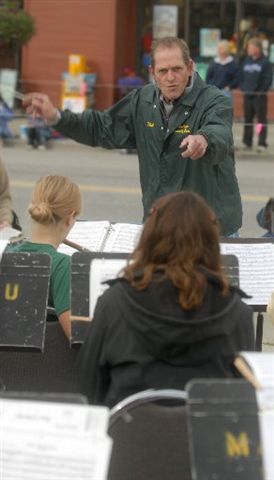
And I watched Dwight, from his first day as principal at Wasilla, until May 2007, when I gave up the baton of the Mat-Su College Community Band, an ensemble that had met in the WHS band room every Monday for the 13 years I directed it. The main reason I stepped down from that post was the feeling I got from the increasingly strident fundamentalist and evangelical constituency in the Valley - not so much from within the band itself - that unless one has been born again, one isn't a real person. The pressures on educators and administrators in our school district from these kinds of people is relentless and could wear down any administrator.

In the wake of Sarah Palin's selection as John McCain's running mate in 2008, our schools were put under even more pressure by these people, and by locals who were fervent Palin supporters. I know from listening to kids during the fall of 2008, that the bullshit kids who did not support Palin went through was not as bad at WHS as it was at Palmer High School, for instance. There, one of the teachers went so far as to create a Palin shrine in his classroom, and was backed by the administration there when kids and their parents complained about the stifling atmosphere in his class. None of that was reported to be happening at WHS.

I suggested to Dwight that perhaps the best way to get the word out on what the choir is actually doing is to get the kids to sign releases and post them singing Bohemian Rhapsody in their version on Youtube. He seemed reluctant to do that or allow me to do it - I have a Youtube channel. He did invite me to come in and hear them rehearse their commencement material next week, when they practice it at the Menard Sports Center. I hope to do that.

Dwight complained that my picture comparing him to Elton John ("separated at birth?" was the caption) was over the top. I rejected that, advising him to lighten up a bit.

I apologized to him for not attempting to get in touch with him before posting on the song's status, and for blithely taking Frontiersman reporter K. T. McKee's story at face value. He suggested I pose some questions to McKee in answer to questions I asked of Probasco. Right after I got off the phone with Dwight, I e-mailed and called McKee. I called again this morning.

An email from McKee just arrived, which is printed here in full - as per her request:
It's unfortunate Mr. Probasco was not willing to talk to me when I called him about the issue before the story was printed. He referred me to the senior class advisor, Deb Haynes. He told me she had a press release, but when I called her, she didn't seem that knowledgeable about the issue, either, and did not prepare a written statement. I tried to reach the choir teacher, but she never responded to my email or phone messages before the article was written (I still have not heard from her.) My information for the story was based on reliable information from trusted choir members and someone within the school who shared information about emails sent to staff on the issue.

My own feeling about singing the song at a graduation ceremony is that the choir teacher could have chosen a more uplifting, inspirational piece. I believe the entire senior body should have had a chance to vote on what song the choir sings at their ceremony. I remember resenting the fact that a small group of students was allowed to pick songs for prom, etc. when I was in high school in the late '70s, early '80s in Anchorage.

I happen to love the song simply because it is so interesting, but it is pretty heavy and its meaning and intent has been disputed for the past 30 years. However, I'm sure the teacher had to get permission from the administration to use the song at graduation in the first place, so it is curious why the teacher was told otherwise so close to the ceremony. Then, after the issue created an uproar among students, they were given permission to go ahead and do it.

I would love to know what Probasco told you in the 40 minutes you spoke with him. However, unless I speak to him directly, I can only consider the information hearsay. It is no secret that Progressive Alaska has its own political agenda and bias.

If you wish to use my statements here in your blog, feel free. I ask that you do not edit them or use them out of context, however. Also, I do not speak for the Frontiersman. These are my own thoughts and feelings on the issue.

K.T. McKee
Reporter, Frontiersman
I'm not in Probasco's shoes. His claim that his responsibility in creating content for any commencement, is to make it the most satisfying graduation experience for the maximum percentage of kids and parents attending, is compelling on one level. I've never administrated a school, much less a high school that, through its connection with Sarah Palin's past, has become the butt of thousands of jokes.

I pointed out that my own record on music that might get a hostile reception is divergent from what he appears to be doing in this case. Even within the confines of the Wasilla High School band room, our community band rehearsed my own music that mocked then-Rep. Vic Kohring for his views on Alaska Native arts, and on the state's privatized correctional system. And then, when it was ready, not only did we perform it, but Vic introduced a 1996 work whose veiled premise was that he might someday end up in prison. He did - twelve years later. Needless to say, after the performance, both Mat-Su College and Wasilla High School got lots of calls from people who wanted me fired.

I lasted another 11 and 1/2 years.

This is Dwight's last year at Wasilla. He's retiring. I apologized to him for helping raise a disruptive issue so close to a time he will want to cherish. I don't agree with what has been done to this song, though. Many songs sung at high school concerts and ceremonies have lyrics that could easily be termed inappropriate by parents or school district thought police.

Here's the program note to the piece dedicated to Vic, that we prepped at WHS - And He Stilled the Drumming:
This piece is dedicated to State Representative Vic Kohring, who has been working hard to end state funding for the arts, and even harder to foster hostile attitudes toward artists. I imagine a young man involved in the Native drumming renaissance. State funding which assisted his drumming group ends, and it folds. In his disappointment he turns to drugs. He's arrested by one of the police hired by funding taken from the state arts council. He then is sent to one of the privately owned prisons championed by Representative Kohring. As the young man beats a mournful pounding on the thick wall of his cell, the piece ends.